Article de presse
Baromètre QIMA 2026 du premier trimestre 2026 : les chaînes d’approvisionnement ont évité le pire, en 2025 – resteront-elles résistantes en 2026 ?
Jan 15, 2026
Télécharger la version PDF ou écoutez notre podcast Supply Chain Soundbites sur YouTube ou Spotify.
Écoutez maintenant : Analyse en 5 minutes des tendances mondiales du premier trimestre 2026
TL;DR
Les chaînes d’approvisionnement mondiales sont restées résilientes en 2025, malgré les tensions commerciales entre les Etats-Unis et la Chine, les chocs tarifaires et la demande d’acheteurs changeante. Les données d’inspection et d’audit de l’AQMI révèlent la diversification des records, les principaux changements d’approvisionnement régionaux à travers l’Asie Pacifique et la Méditerranée, ainsi que les liens commerciaux prospères entre le Sud et le Sud. En 2026, les acheteurs continueront de développer des réseaux de fournisseurs multi-régionaux afin d’atténuer les risques et de maintenir l’agilité.
Les chaînes d'approvisionnement mondiales ont prouvé leur résilience en 2025 dans la face du commerce et les pressions géopolitiques
Malgré les chocs engendrés par le changement des politiques commerciales américaines, les chaînes d’approvisionnement mondiales ont fait preuve d’une souplesse et d’une résilience notables en 2025. De nouveaux partenariats commerciaux et la forte performance des économies émergentes ont ouvert des possibilités significatives de diversification, aider les achats mondiaux éviter les scénarios de perturbation du pire cas.
En même temps, les perspectives commerciales plus larges restent fragiles. Cette incertitude incite les acheteurs et les fournisseurs à accélérer leurs stratégies de diversification et à se concentrer sur la résilience alors qu'ils se préparent à un environnement mondial plus volatil en 2026.
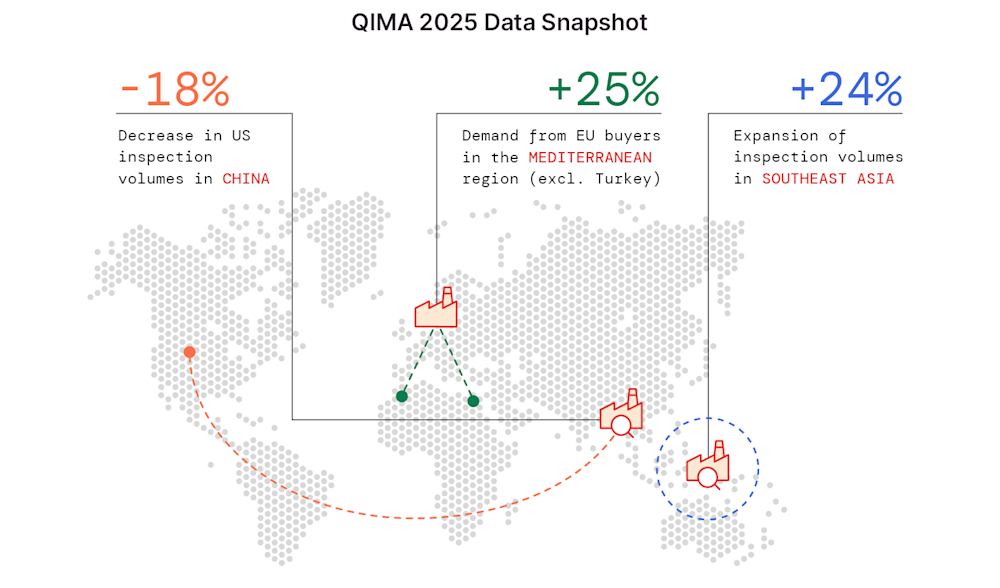
Capture de données QIMA 2025
La Diversification de la chaîne d’approvisionnement touche tout le temps haut
Les données QIMA sur les inspections et les audits montrent que tant les acheteurs que les fournisseurs ont pris des mesures actives pour diversifier leurs réseaux et réduire les risques en 2025, une tendance qui devrait se poursuivre l'année prochaine.
Les principaux marchés acheteurs ont observé une diminution de la concentration de l'approvisionnement pour des produits de consommation tels que les vêtements, les jouets et les articles ménagers. Pour les acheteurs nord-américains, la part combinée des trois premiers pays fournisseurs (Chine, Inde, Vietnam) est passée de 61 % à 54 % en une seule année. Les marques d'Europe occidentale ont connu un changement plus lent mais constant, avec les trois principaux fournisseurs (Chine, Vietnam, Bangladesh) représentant 70 % des inspections et audits en 2025, contre 77 % en 2021. Dans les deux régions, la réduction des affaires avec la Chine a été le principal moteur, mais une grande partie des volumes redirigés de la Chine est allée au-delà des deuxièmes et troisièmes plus grands marchés fournisseurs. Du côté de l'offre, les exportateurs chinois se sont concentrés davantage sur les marchés émergents. La part des clients sud et latino-américains dans les inspections et audits en Chine a atteint 30 % en 2025, tandis que la part des clients nord-américains et occidentaux européens représentait ensemble moins de la moitié, soulignant la nature de plus en plus multipolaire des chaînes d'approvisionnement mondiales et le rôle clé du commerce Sud-Sud comme moteur de croissance.
Fig. 1 : Évolution des trois principales régions d'approvisionnement pour les acheteurs nord-américains et européens, 2021-2025
![QIMA[barometer][Q1_2026]_Figure1](http://images.ctfassets.net/0c6y4qslwvqw/7zvGGvBqFNBDLNGRYmtOnM/3ba22f2c180de9e8bb803da625c35e8a/QIMA-barometer--Q1_2026-_Figure1.png?w=1000&fm=png&q=60 "QIMA[barometer][Q1_2026]_Figure1")
Les chaînes d’approvisionnement américaines se sont penchées sur les concurrents chinois pour naviguer en 2025
Les modèles d'approvisionnement américains ont fortement changé tout au long de 2025, avec des pics entraînés par un surstockage avant les hausses tarifaires et des creux en dessous des niveaux de 2024. Malgré cette turbulence, les données de QIMA montrent une fin d'année 2025 positive pour les approvisionnements américains, avec une demande en inspections et audits en hausse de +9 % d'une année sur l'autre sur les 12 mois de 2025.
Les concentrateurs de fournisseurs en Asie ont joué un rôle clé dans le soutien des chaînes d'approvisionnement de biens de consommation américaines pendant cette volatilité. La demande d'inspection et d'audit a augmenté à deux chiffres dans la plupart des pays de l'Asie du Sud-Est (+42 % YoY dans la région) et en Asie du Sud (+14 % YoY), alors que la demande pour le sourcing de la Chine a diminué de -18% YoY.
La relocalisation et la relocalisation proche ont également contribué à la croissance, bien qu'elles restent une part relativement petite de l'ensemble des approvisionnements, ne montant que légèrement à 7,6 % en 2025 (contre 7,1 % en 2024). Alors que la demande dans les principaux marchés de relocalisation proche tels que le Mexique et le Guatemala était modérée, la demande d'inspections nationales aux États-Unis a augmenté chaque trimestre, suggérant que les stratégies d'approvisionnement des États-Unis pour 2026 incluront probablement une relocalisation à échelle limitée.
Fig. 2 : Tendances de la demande d’inspections et d’audits aux États-Unis, mondialement, 2024-2025 (variation d’une année sur l’autre)
![QIMA[barometer][Q1_2026]_Figure2](http://images.ctfassets.net/0c6y4qslwvqw/4KSvn4K2ToB3OQpkeR2Xls/8afe7c9e4160f02481033fa3efcd1729/QIMA-barometer--Q1_2026-_Figure2.png?w=1000&fm=png&q=60 "QIMA[barometer][Q1_2026]_Figure2")
Les acheteurs européens courent les risques par le biais de partenariats outre-mer et régionaux
Les tendances d'approvisionnement européenne continuent d'être influencées par les évolutions de la sentiment des consommateurs et les conditions économiques globales. De plus petites économies telles que les Pays-Bas, l'Espagne et l'Autriche ont enregistré une forte activité d'approvisionnement en 2025, tandis que la demande était plus atténuée au Royaume-Uni, en France et, dans une moindre mesure, en Allemagne.
Confrontées à des conditions fluctuantes dans leur pays et à un environnement commercial imprévisible à l'étranger, les données d'inspection et d'audit de QIMA suggèrent que les acheteurs européens sont prêts à maintenir leurs relations avec les fournisseurs existants tout en réduisant les risques par la diversification. La Chine est restée un partenaire d'approvisionnement important pour les produits tels que les jouets et les produits électriques, mais la croissance la plus rapide de la demande d'inspection est venue des centres d’Asie du Sud-Est, comme le Vietnam (+12 % d'une année sur l'autre), la Thaïlande (+23 % d'une année sur l'autre) et le Cambodge (+6 % d'une année sur l'autre).
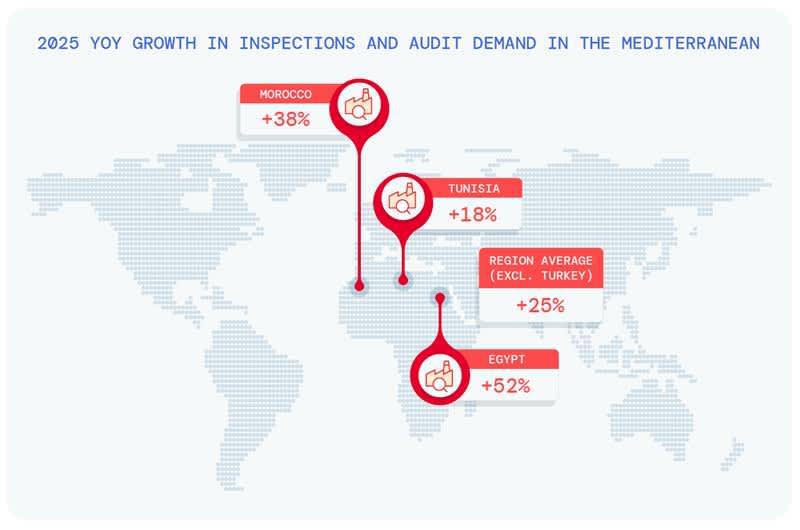
À l’avenir, il est probable que l’approvisionnement régional continuera à jouer un rôle clé dans les stratégies de résilience. Au cours de la dernière année, a atteint un taux record de 14% de l'approvisionnement de l'UE, avec la région méditerranéenne enregistrant une forte croissance (+25% YoY). Tandis que le secteur textile de la Turquie a lutté contre avec une hausse des coûts et des pénuries de main d’œuvre, L’Égypte (+52%), le Maroc (+38%), et la Tunisie (+18%) ont pris de l’ampleur, soutenus à la fois par les nouvelles affaires et les réaffectations des commandes dans la région.
La diversification des marchés d’exportation de la Chine accélère le commerce Sud-Sud
En 2025, les tensions commerciales entre les États-Unis et la Chine ont davantage encouragé les chaînes d'approvisionnement américaines à éloigner l'approvisionnement de la Chine. En réponse, les exportateurs chinois ont intensifié leurs efforts de diversification, en renforçant les liens avec les marchés en développement et les économies avancées hors des États-Unis – une tendance qui devrait s'accélérer en 2026.
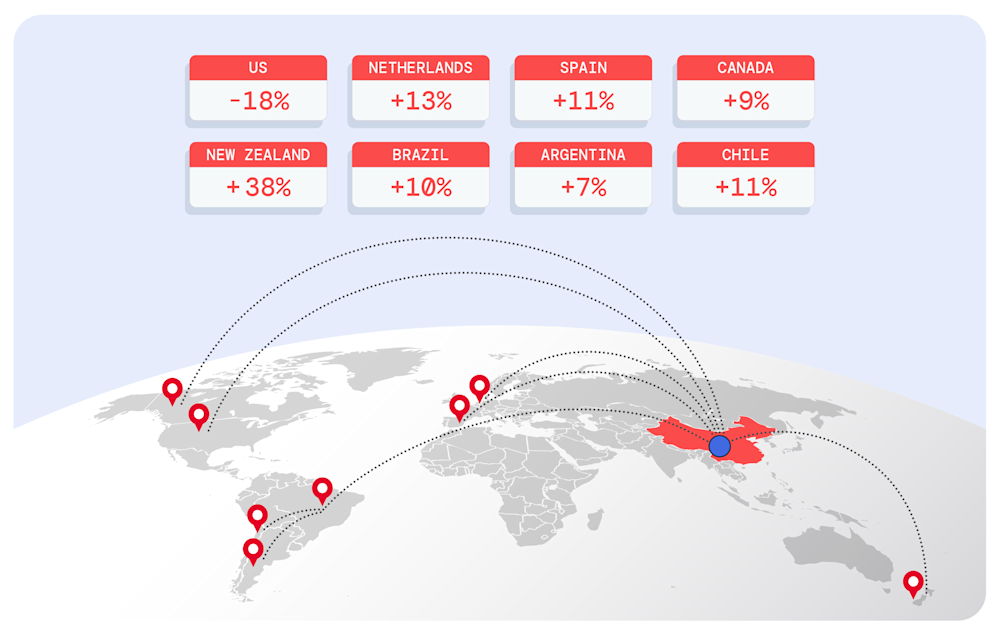
Alors que la demande américaine pour les inspections et audits en Chine a chuté de -18 % d'une année sur l'autre sur les 12 mois de 2025, la baisse a été partiellement compensée par d'autres acheteurs occidentaux. Les données de QIMA montrent que de nombreuses marques européennes continuent de compter sur la Chine pour les textiles et les vêtements, avec des augmentations notables au quatrième trimestre venant de l'Italie, de l'Espagne, de l'Autriche, du Royaume-Uni et des Pays-Bas. Au-delà de l'Europe, la demande d'inspection a également augmenté en Canada (+9 %d'une année sur l'autre), Australie (+2 %d'une année sur l'autre), et Nouvelle-Zélande (+38 %d'une année sur l'autre).
L'Asie du Sud-Est a déclaré sa position de centrale d'approvisionnement mondial
En 2025, l'Asie du Sud-Est a renforcé sa position de l'un des principaux moteurs de croissance du commerce mondial, avec la croissance de l'activité d'approvisionnement à chaque trimestre. Les données QIMA montrent la demande d'inspection et d'audit dans la région en hausse de +24% YoY, menée par le Vietnam (+30%) et la Thaïlande (+44%). L'Indonésie (+13 %), le Cambodge (+16 %) et les Philippines (+13 %) ont également enregistré une forte croissance.
Notamment, les inspections des acheteurs américains et européens ont augmenté au même rythme que la moyenne régionale, tandis que la demande de la part des clients américains et sud-américains a bondi de 61 % d'une année sur l'autre au cours des 12 mois de 2025. Cela suggère que l'Asie du Sud-Est a le potentiel de rester une région clé d'approvisionnement en 2026, avec la capacité d'accepter plus de commandes à mesure que les chaînes d'approvisionnement occidentales se diversifient, et que l'afflux de nouvelles affaires en provenance d'autres marchés émergents.
Partager ceci sur